
Inquest shown terrifying video of flood engulfing car and trapping grandparents in fatal Queens Drive tragedy
“Volatile” conditions may have caused a grandad to struggle to see standing water before his car became undriveable and leaving him and his wife trapped in rising floods.
The second day of the inquest into the deaths of beloved married couple Elaine and Philip Marco heard from emergency service officers who attended Queens Drive on August 26 2023 when the couple’s vehicle became submerged in torrential flash flooding.
The couple, who were well-known in south Liverpool and in the city’s Jewish community, were just a few days away from their 54th wedding anniversary when the tragedy happened. A Merseyside Police forensic collision investigator told the hearing how the Mercedes car the grandparents were travelling in became hydrolocked after water got into the engine.
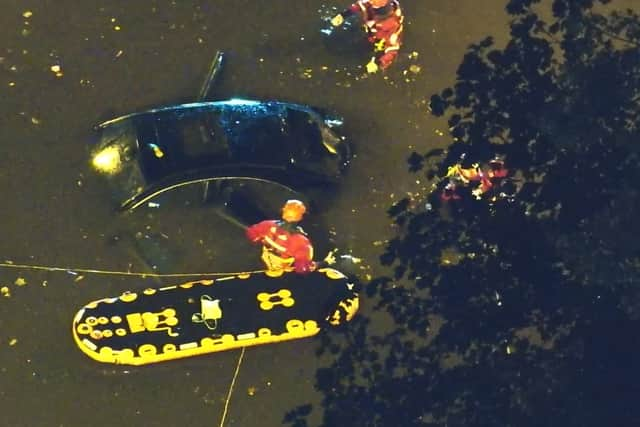

PC Elliott Creed said such was the amount of rainfall on August 26, 2023, Mr Marco – who had been driving the car – may not have been able to clear his windscreen sufficiently to identify the rising water in time to stop and could have driven into the water unknowingly. He presented footage to the Gerard Majella Courthouse including mobile phone videos taken on the evening of August 26 as the water moved rapidly under the bridge like waves.
PC Creed said he could not detect any defective surfacing, contaminants or any other issues that could have contributed to the collision. His statement set out how the Marcos’ son, Simon, told police he had spent the evening with his parents celebrating his brother Joshua’s 40th birthday.
Mr and Mrs Marco were in good spirits and looking forward to spending Christmas with their family. Simon Marco said his father dropped him off around 9pm before travelling with his mother in the direction of their own home.
This was the last time he would see his parents alive.
A witness statement from Emily Fleetwood, who was travelling in a taxi that night, said she saw a large vehicle travelling in the opposite direction to the Marcos’ car and pass under the bridge. Ms Fleetwood said the Marcos’ car appeared to be travelling at around 20mph with the headlights on.
In a statement from taxi driver Mahmoud Ahmedsaid, it was said the bottom half of the car had become submerged in the water and he saw a man walking towards him who appeared to be shouting and waving his hands. Neither man could hear one another due to the continuing rainfall, with Mr Ahmedsaid describing a ‘waterfall’ coming over the bridge above.
As the water continued to rise, the taxi driver said the man was in the water up to his shoulders and appeared to be carrying somebody. The exchange lasted around six minutes during which the man Mr Ahmedsaid saw in the water never came any closer to him.
Zoe Tater had been on a night out and was travelling home when she saw a “huge lake” under the bridge. The inquest heard how she got out of the vehicle she was in and saw someone “waving in distress.” She made attempts to aid the person before seeing a body under the water.
Matthew Davies was with Ms Tater and his statement set out how the water was flowing “like a torrent” along Queens Drive.
PC Creed undertook work alongside David Cook, Merseyside Police vehicle examiner. Mr Cook’s analysis said water getting into the engine of the Marcos’ car would have caused ‘catastrophic’ damage known as hydraulicing or hydrolocking, effectively rendering it immovable.
He concluded there had been no defects on the car before it entered the standing water.
PC Creed’s investigation identified that the flooding had a length of 182 metres and a depth of three metres. By comparison, the Marcos’ Mercedes stood at 1.87m in height.
The collision investigator said it was clear Mr Marco had driven into the water but may have done so unknowingly. PC Creed said it was possible Mr Marco may have misjudged the depth of the water as he drove into it, or a bow wave may have been caused as he entered the water, hydrolocking the engine.
He added how a wave could have also been created by a car travelling in the other direction. PC Creed said another possible scenario given the “volatile weather conditions and extraordinary rainfall” was Mr Marco may have been unable to see and identify the standing water on Queens Drive having not been able to clear his windscreen due to the intensity of the rainfall.
The investigator said: “This, in turn, may have led Mr Marco to have identified the standing water at too late a stage in order to stop his vehicle ahead of entering or to have entered the standing water unknowingly.”
PC Lee Burgess, of Merseyside Police’s MATRIX unit, wrote in his statement presented to the court how the area was known to flood and he recalled how on the night of August 26, this was “worse than I’d ever seen before.” PC Lee Burgess followed up with officials from Liverpool Council, including duty traffic officer Lee Welsh who told him the city council had been in consultation with United Utilities over the sewer capacity on Queens Drive for “a number of years.”
According to the police officer Mr Welsh said there had been a meeting regarding the installation of automated barriers around the bridge in the week previous to the Marcos’ death but he was not aware of the outcome of the discussion. Neil Mooney took command of the scene on behalf of Merseyside Fire and Rescue when he attended just after 9.30pm.
He told the court how the water was rising rapidly and had become “turbulent.” Two swift water swimmers were deployed with a raft to conduct a search with a further two officers tethered to unblock drains.
Mr Mooney said fire officers estimated the water level standing at between 12 to 15 feet. At around 10.30pm, the firefighter said levels began to decrease.
He said: “What we were faced with was like the River Mersey on a stormy night.”
PC Robert Langton said he was made aware of the collision at 9.30pm and was deployed to assist with the road closure. He told the inquest how visibility was poor driving to the scene, describing the rain as “biblical.”
PC Langton added how the driving conditions were ” some of the worst” he had seen and how he was in “disbelief” at what he found on arrival at the scene. The police officer said: “You expect a rather large puddle, I couldn’t believe my eyes.”
He said how on arrival, he could see a “dark pool” of water and he and a colleague had made efforts to clear grids by hand that had become blocked with twigs and leaves.It was after this he said he began to hear water moving through the drains and clearing.
In his statement, shown to the court, PC Langton said: “I am absolutely staggered that something as tragic as this could happen in a city like Liverpool.” He wrote how he would usually associate the events with countries associated with flash flooding.
The police officer also questioned in his statement why barriers hadn’t been installed sooner, similar to ones implemented in St Helens at a known flooding point.
At the scene, PC Langton said how visibility had been poor due to street lighting and while it had been a clear night, the “road and water merged into one.” Regarding the dip in the road under the bridge, the officer said: “You only know about it when you’ve gone on top of it.”