
The 114-year-old story of Liverpool's most iconic landmark, the Royal Liver Building

Discover the rich history of Liverpool's iconic Royal Liver Building, with its legendary Liver birds and impressive clock towers. Explore the architectural marvel and its significance to the city's cultural and historical landscape.
Standing tall at the city's waterfront, the Royal Liver building has long been a symbol of Liverpool's maritime heritage and its importance as a global trading hub. But, its story goes much deeper than just its imposing presence.
With the famous Liver birds perched on top and the distinctive clock towers, it's one of the most recognisable buildings in the entire city. Its story begins over a century ago in 1911 when construction was completed - after three years.
The building was designed by architect Walter Aubrey Thomas, constructed as the headquarters for the Royal Liver Group. Standing at an impressive 18-foot-tall, the birds which adorn the top of the building are actually made of copper, hence their iconic blue-green patina colour - caused by oxidisation.


Affectionately named Bella and Bertie, Bella looks to sea, watching for the sailors to return home safely, whilst Bertie keeps watch over the city. The famous Liver birds have never actually existed in nature, having taken on a mythical history similar to the likes of the phoenix. But, legend has it that if they were to ever fly away, the city would cease to exist.
In total, there are four clock faces on the two towers. The clocks are the largest electronically driven clocks in the UK and were started on June 22 1911, to coincide with the exact moment of the coronation of King George V and were therefore proclaimed to be called the Great George Liver Clocks.
They were designed by Gent and Co, a company who created a waiting train movement mechanism for these clocks. Before they were officially set into the building in November 1910, one of the clock faces was used as the table for a banquet to celebrate the achievement of the construction, where dignitaries enjoyed a huge full-course meal.
A copy of the menu served can be seen at the Liver building and Judy the donkey was the guest of honour at the opening. The mayor wanted Judy to cut the ribbon, however, instead peanut butter was smeared on the ribbon and Judy chewed through it. Loved by the people of the city, Judy was a familiar figure in Princes Park, where she was adored by children who visited her.
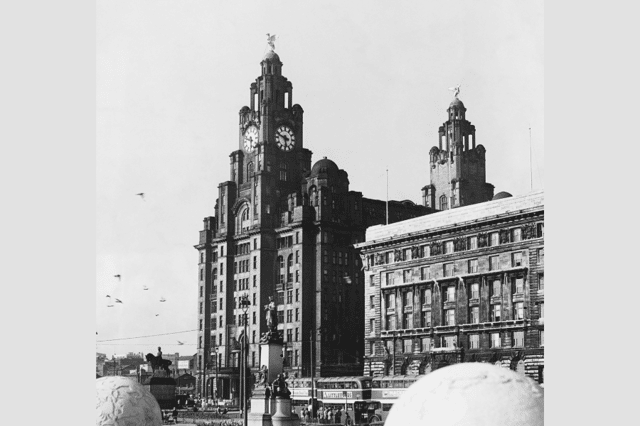
Today, RLB 360 is the building's visitor experience, offering guided public tours of the Grade I listed building, clock tower and 15th floor, unlocking incredible views across the river, docks and beyond.
The immersive audio-visual experience projected onto the walls of the clock tower brings the city's past to life, telling the story of Liverpool's recent history, exploring the building's significance and how a city full of culture, sport, history and music has made its mark across the world.
Europe's first skyscraper, the Liver Building’s impressive size symbolises the city's wealth as the city was a major port during the 19th and early 20th centuries. It was a centre of trade and emigration and of course, the transatlantic slave trade.
Watch the full video - created by our video journalist Emily Bonner - above for more.