
Beyond EU roaming: Connectivity solutions for travel to America, Asia, and beyond


Imagine coming back from holiday to find a £25,000 mobile bill waiting for you at home?
That’s exactly what happened to a Reddit user, who racked up the charge after using his phone for just seven hours abroad. And while that might sound extreme, many UK travellers today face shocking roaming charges outside the EU.
Roaming charges are unregulated, often inconsistent and exorbitant, especially in the USA and across much of Asia. For instance, USA roaming can cost anywhere from £5 to £15 per MB. Just a few hours of streaming can leave you owing several hundred pounds!
How then to stay connected while travelling from the UK to the USA and other non-EU countries on a roaming plan that won’t cost an arm and a leg?
This article details tips for avoiding high mobile bills when travelling to Asia and the USA, and how international roaming alternatives, such as eSIM for travel, can help you save on roaming costs.
The hidden costs of international roaming
Each major UK carrier sets its own roaming rates depending on the destination. They typically cover charges for texts, calls and mobile data. In some cases, the costs are surprisingly high and don’t always follow a clear logic
Using mobile data abroad, outside the EU, is often much more expensive and can reach £5 per MB or more; the same goes for text and calls. Background apps and updates increase your roaming charges often without you noticing until the final bill arrives.
Jose's family received a $13,470 bill after using an iPhone for just 30 minutes during their trip to Vietnam. The reason for the unimaginable bill? Background apps were running on the iPhone and using up data. Similarly, Luke, a non-profit founder, didn’t check international roaming charges during his trip to the Maldives and was charged $6,079.
Common apps like Zoom, Google Maps and social media platforms are heavy on data usage. For instance, a 30-minute HD video call alone can consume 400-600 MB of data. Most UK mobile carriers have a fair use policy with a monthly limit of 12-25 GB on data plans for travellers.
Any usage beyond this can incur heavy costs, slow internet speed, or leave you without a connection. Vodafone and EE both specifically mention in their terms and conditions.
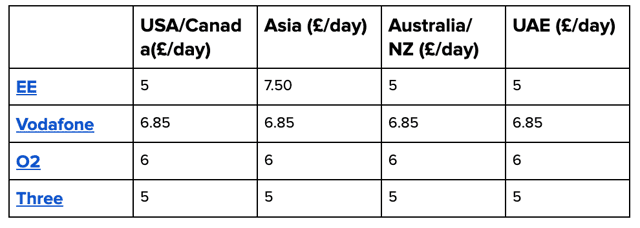

Traditional solutions and limitations
Many traditional connectivity solutions can be used to save on roaming costs, but they each have advantages and disadvantages.
- Buying local SIM cards: You could buy a local SIM in the country you are visiting and enjoy low rates, sometimes with unlimited data. However, getting a local SIM comes with eligibility requirements and may take a few hours or more to activate. Also, you would have to use a new number each time you travel to a new location, which is not always convenient. Phone incompatibility issues and other cultural and language barriers may also occur.
- International travel SIMs: To avoid local SIM hassles, you can opt for an international travel SIM, which provides multi-country coverage. International SIMs may be good for frequent travellers who are often on the move. However, international SIMs come with roaming charges that are predictable but still expensive. Data speed and coverage may vary across regions, and customer service may not be consistent globally.
- Public Wi-Fi: Dependence on public or hotel Wi-Fi may be practically free or included in hotel costs. Public Wi-Fi is available at most airports, cafes, and hotels, and doesn't require any setup. However, it is highly unreliable and prone to security risks. Since public Wi-Fi quality can vary every few kilometres, relying on it isn’t always practical. It may help with calls and navigation, but it shouldn’t be your only connectivity solution when travelling.
- Simply accepting roaming charges: Accepting high roaming charges might make sense if the situation is urgent or the trip is very short. You can reduce the risk of high roaming charges by keeping an eye on your app usage, adjusting your phone’s settings, and using mobile data only when necessary.
But if you want to avoid roaming charges entirely, modern solutions like Yesim’s eSIM cards can be a smart alternative.

eSIM technology as a modern solution
An eSIM is an embedded card that uses digital SIM technology. Unlike regular SIM cards, they don’t need to be purchased or physically swapped when switching networks or numbers.
eSIMs can be bought, activated, and switched between providers online. All you need to know is how to activate eSIM. Most operators have a step-by-step guide to using eSIM for the first time. Most phones, including iPhones, Google, and Samsung models, are compatible with eSIMs.
If you opt for one while travelling, you will save on roaming costs and the hassle of interchanging physical SIMs or finding local mobile carriers during your stay abroad. For instance, popular eSIM providers like Yesim offer flexible data travel plans, with features such as switchless networks, 1-click installation, free VPN, and 24/7 customer support across 200+ countries.
eSIM cards offer more flexible data plans that reduce roaming costs and allow users to switch to local data plans with a few clicks. With fair usage restrictions, a traditional roaming plan can cost £90 to £100 for a two-week trip to the USA. Comparatively, eSIM providers like Yesim offer an unlimited data plan for just $51 for a similar trip to the USA.
Moreover, international travellers can choose from data-only, prepaid, pay-as-you-go, or regional plans that provide connectivity for multiple countries at affordable rates.
Practical advice for different travel scenarios
If you are a UK citizen, a few tips can come in handy when travelling abroad, especially outside the EU:
1. While searching for a data plan for travellers, note whether the mobile carrier supports services in that destination and has affordable rates.
2. If on a business trip, prefer secure, private connections rather than public Wi-Fi, mind time zones, and conserve mobile data to stay reachable at all times.
3. Family trips can be challenging if multiple members share an internet connection between devices. When buying data plans for multiple family members, consider their usage, social media habits, etc., set limits and keep children's devices online for easy tracking.
4. If you are a long-term traveller, a good eSIM monthly plan with unlimited data can be a great solution. Just make sure to set it up before your trip and balance it with your local SIM contract.
5. Always try to minimise data usage, set up alerts, download offline maps, and use a VPN when connecting to public Wi-Fi for security. Instead, you could also use Yesim’s free VPN and SwitchLess Networks technology to enjoy the best connectivity at all times.
Conclusion
When travelling abroad, it's important to stay connected and avoid high roaming costs. eSIM solutions like Yesim offer excellent Asia travel connectivity and are one of the most affordable ways to use the internet in America.
So, whether spotting kangaroos in Australia, enjoying nightlife in Miami, USA, or trying new sushi flavours in Japan, make the best of your time and enjoy with hassle-free connectivity from a modern solution.