
Search for descendants of six Liverpool gas workers killed during the First World War
More than a century after their deaths, Cadent – which manages the gas network today – is hoping to find relatives of Samuel Corfe, James Hitchmough, Richard Ireland, Alexander McDonnell, Allan Prophet and John Williams.
They are named on two memorials which are now housed at the company’s base in Huyton – and Cadent is keen to make sure their relatives know these exist and have opportunity to pay their respects, particularly on Armistice Day.
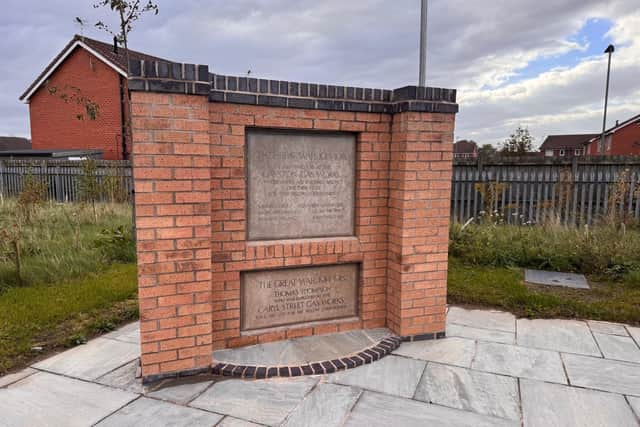

Every year, modern-day employees of Cadent gather at the memorial on 11 November, to pause for a moment of reflection and silence.
In more recent years, they have been joined by the great-niece of Thomas Thompson, to whom one of the two memorials is dedicated.
Thomas was 24 when he was killed as his unit advanced into Belgium in October 1918. Before the war, he worked at Caryl Street gas works, which at that time was a huge gas production site close to what is now Brunswick train station.
His father, Robert, was a foreman at the site and – at some point soon after Thomas died – a memorial stone was engraved and added to the wall at the site.
Fast-forward more than 100 years and this site is today a much smaller gas pressure management station, accessed by only a handful of workers.
A decision was taken several years ago to move the memorial to a location where more people can see it, and it now sits outside the headquarters for Cadent’s Merseyside operations, which is in Huyton. A plaque was placed on the exterior, public-facing wall of the original location of Thomas’s memorial.
The original was merged with another memorial dedicated to ‘the men employed at the Garston gas works … who gave their lives for their fellow countrymen’.
Now Cadent is keen to make sure the descendants of the six men named on that memorial know it exists and can join them in paying their respects.
Nick Jerman, Head of Safety and Engineering, and the regional lead for the Cadent Military Community, said: “Cadent is proud to have a history that dates back to the early 1800s here in Liverpool.
"Thousands of Merseyside gas workers served in both of the world wars, and many were killed. As a company, we pause every year to remember that.
"It has been wonderful to welcome Thomas Thompon’s great-niece to join us every year and we want to extend the opportunity to all descendants.”
Online searches of the six names inscribed on the Garston gas works memorial suggests the following:
Private Samuel Corfe served with the Royal Welsh Fusiliers. He died on 11 September 1918, age 34. He was the son of Thomas and Eleanor Corfe, of Garston, and husband of Annie Corfe, of Lincoln Street, Garston.
Stoker 1st Class Allan Prophet served in the Royal Navy. He was 20 when he died, when HMS Black Prince was sunk in the Battle of Jutland. It is thought his parents, William and Martha Prophet, lived in Derby Street, Garston.
Private Richard Ireland, of the King’s Liverpool Regiment, was killed in Belgium in February 1918, age 30. He lived in Aston Street, Garston.
Private John Williams, of the King’s Liverpool Regiment, was killed in France in July 1918, age 42. It is thought he lived in Otway Street, Garston.
Lance Corporal Alexander McDonnell, of the King’s Liverpool Regiment, was killed in France in May 1915, age 21. His parents, Alexander and Margaret McDonnell, lived in Argyle Road, Garston.
There is reference to a Lance Corporal James Hitchmough serving with The Loyal North Lancashire Regiment in the First World War. He was killed in November 1914 and his name is added to the Ypres (Menin Gate) Memorial in Belgium.
To contact Cadent about this, email [email protected]
Cadent manages the gas distribution network in North West England, which includes more than 21,000 miles of underground gas pipes and hundreds of above ground pressure management stations. It also provides the region’s gas emergency service.
Seven employee-led communities – one of which is the Cadent Military Community – foster a culture of inclusivity among its UK workforce of more than 6,000 people.