
Chester Zoo: Special moment endangered okapi is born - with doting mum gently encouraging him to his feet
Watch CCTV of the birth of an okapi at Chester Zoo, with the calf taking his first steps minutes later.
Incredible footage shows the birth of an okapi at Chester Zoo - born in the early hours on May 6 to mum Ada, and dad Stomp.
The footage shows the calf falling to the ground, before clambering to its feet only minutes later and taking its first wobbly steps - a special moment that very few people in the world have ever witnessed.
Zookeepers have now revealed that the calf is male and they’ve named him Miloli, which translates to ‘Joy’ in Bantu, a family of languages spoken in central Africa.
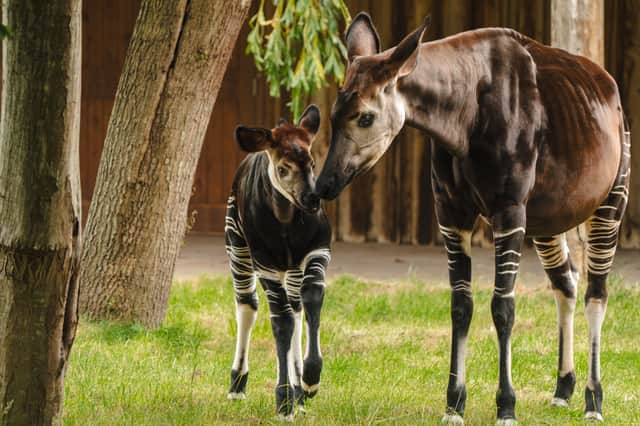
Having spent the first few weeks of life in a quiet, hidden nest, the youngster has now gained in confidence and has stepped into the sunshine for his first outdoor adventure. Found only in the dense rainforests of the Democratic Republic of Congo (DRC), the okapi is so elusive that it went undiscovered to western science until 1901. As a result, they’ve been nicknamed the ‘African unicorn’.

The world’s authority on the state of nature, The International Union for the Conservation of Nature (IUCN), has classified the species as Endangered on its Red List of Threatened Species.
Fiona Howe, Lead Keeper at the zoo, said: “The birth of an okapi is always a very special occasion and cause for celebration, but to watch as mum Ada calmly welcomes her new baby into the world and gently encourages him to his feet, was nothing short of magical and offers a special insight into one of nature’s most elusive and secretive species.
“Miloli has spent the first few weeks of life tucked away in a quiet nest area, bonding with mum Ada as she forages for food nearby, periodically returning to feed her new youngster with milk – she’s a doting mum and is doing everything perfectly so far which is just great to see.
“Although it looks like Miloli is sporting black and white stripey socks, these patterns play an important role as, now that he’s gained enough confidence to do so, he has followed the stripes on his mum’s hind legs and has she lead him out of the nest to begin exploring their outdoor habitat for the first time together.”
Sue Walker, Head of Science at the zoo, added: "Our scientists have been supporting okapi reproduction for more than 15 years. By using the latest technologies to test hormones in okapi faecal samples, we can confirm the observations and behavioural changes recognised by zookeepers, and in the process learn more about the species and their biology. These findings have already been used to support the wider international conservation breeding programme that’s safeguarding okapi populations from extinction."