
Liverpool 2025/26 Premier League fixtures: Reds kick off new season at Anfield as two tough games follow
Liverpool will learn the order of their 2025/26 Premier League fixtures this week.
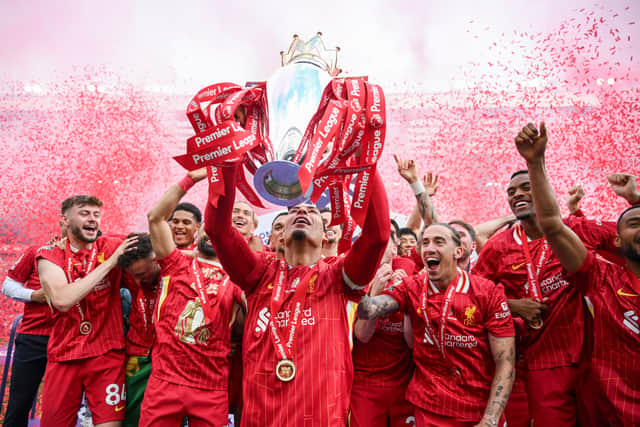
Liverpool are due to discover the running order of fixtures of their Premier League title-defending season. The Reds will be vying to produce a stunning back-to-back triumph, with the club working hard to bring in blockbuster new signings to turbocharge another title pursuit.

Florian Wirtz is poised to undergo a medical on Friday ahead of a club record deal while the Reds are also closing in on Milos Kerkez.
Arne Slot’s champions will come up against familiar faces from last season, as well as the three coming up from the Championship.
Leeds United will re-enter the Premier League fold after coming out on top in the second tier. Runners-up Burnley are also due to return to the top flight after clinching the final automatic promotion spot.
They will be joined by play-off winners Sunderland, who saw out a stunning final performance at Wembley to deny Sheffield United the last promotion place. The Black Cats have not played Premier League football since 2017.
When does the 2025/26 Premier League season start?
The countdown is officially on and the 2025/26 start date has been locked in.
The opening match round will commence on August 15th, 2025 and the season will run until Sunday, May 24th 2026, when all league games will be played simultaneously as usual.
Liverpool’s full 2025-26 Premier League fixture list
Liverpool will begin the Premier League campaign on Friday, August 15th with a home game against Bournemouth as they launch the defence of their title.
August 15th: Bournemouth (H)
August 23rd: Newcastle (A)
August 30th: Arsenal (H)
September 13th: Burnley (A)
September 20th: Everton (H)
September 27th: Crystal Palace (A)
October 4th: Chelsea (A)
October 18th: Man Utd (H)
October 25th: Brentford (A)
November 1st: Aston Villa (H)
November 8th: Man City (A)
November 22nd: Nottingham Forest (H)
November 29th: West Ham (A)
December 3rd: Sunderland (H)
December 6th: Leeds United (A)
December 13th: Brighton (H)
December 20th: Tottenham (A)
December 27th: Wolves (H)
December 30th: Leeds United (H)
January 3rd: Fulham (A)
January 7th: Arsenal (A)
January 17th: Burnley (H)
January 24th: Bournemouth (A)
January 31st: Newcastle (H)
February 7th: Man City (H)
February 11th: Sunderland (A)
February 21st: Nottingham Forest
February 28th: West Ham (H)
March 4th: Wolves (A)
March 14th: Tottenham (H)
March 21st: Brighton (A)
April 11th: Fulham (H)
April 18th: Everton (A)
April 25th: Crystal Palace (H)
May 2nd: Man Utd (A)
May 9th: Chelsea (H)
May 17th: Aston Villa (A)
May 24th: Brentford (H)
How is the Premier League schedule decided?
The Premier League website explains how each season’s fixtures and dates are decided.
“We start when we know the composition of each division, so after the last Football League playoff. We place each club in a pairing grid, which defines the dates they will be at home.
“For every date in the season, the fixture computer knows which clubs are at home and who are away and then it will mix them up randomly to determine the matches. In any five matches there should be a split of three home fixtures, two away or the other way around. A team will never have more than two home or away matches in a row, and, wherever possible, you will be home and away around FA Cup ties.
“A club will never start or finish the season with two home or two away matches because it would be unfair for a team to finish with two aways. Around the Christmas period, if you are at home on Boxing Day you will be away on New Year's Day or an equivalent date.
“We also try to maintain a Saturday home-away sequence throughout the season wherever possible. Most clubs will have a partner club with whom they cannot clash, such as Manchester United and Manchester City, or Liverpool and Everton. In London it gets a bit more complex and less obvious.”